
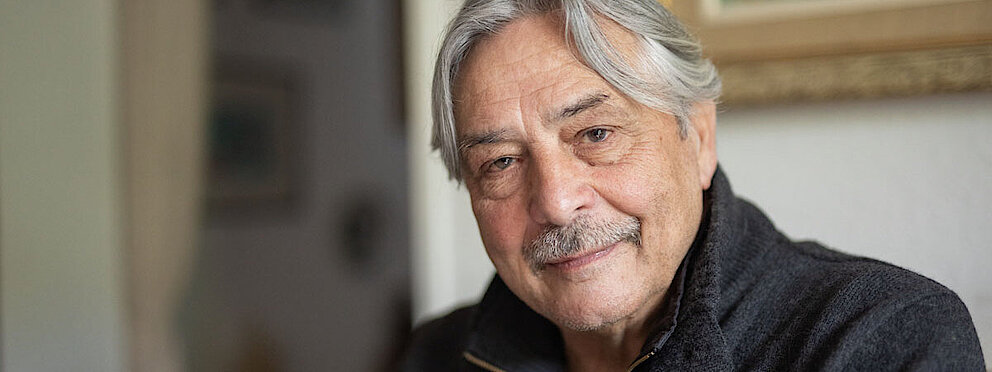
Christian Pfeil
About Christian Pfeil
Christian Pfeil was probably born in Lublin in January 1944. His family had already been deported from their hometown of Trier by the Nazis in 1940 because they belonged to the Sinti minority and were taken to German-occupied Poland. After five years of forced labour in various concentration camps, the Pfeil family was liberated by the Red Army in 1945. However, they were then forced to spend another six months in a labour camp in Odesa.
After returning to Trier, the family rarely spoke about what they had experienced. Christian started school in 1951 and faced considerable exclusion and discrimination. As a result, his family remained the centre of his life. Even as a teenager, he supported his severely traumatised parents and siblings, most of whom were unable to work.
After leaving school, he trained as a car mechanic and travelled through Europe as a fortune-teller and palm reader. At the age of 26, he opened a pub in Trier. It quickly became successful and turned him into a local celebrity. At the same time, he pursued his true passion: singing.
In the 1990s, Christian was targeted by far-right extremists and received death threats. His second venue was vandalised twice within a short period of time and, among other things, defaced with swastikas after a song he had written and performed, featuring anti-fascist lyrics, was broadcast on television. He subsequently ended his public singing career, closed his restaurant and left Trier for many years.
Near the Luxembourg border, he opened a third successful restaurant. He retired in 2015, returned to Trier and began to research and publicly share his family’s story. In 2022, he spoke as a Holocaust survivor at Auschwitz-Birkenau for the first time. He later also addressed the European Parliament and the United Nations in New York.
"Tell young people this story. I believe it is so important that they engage not only with my story, but also with the persecution of Sinti and Roma as a whole."
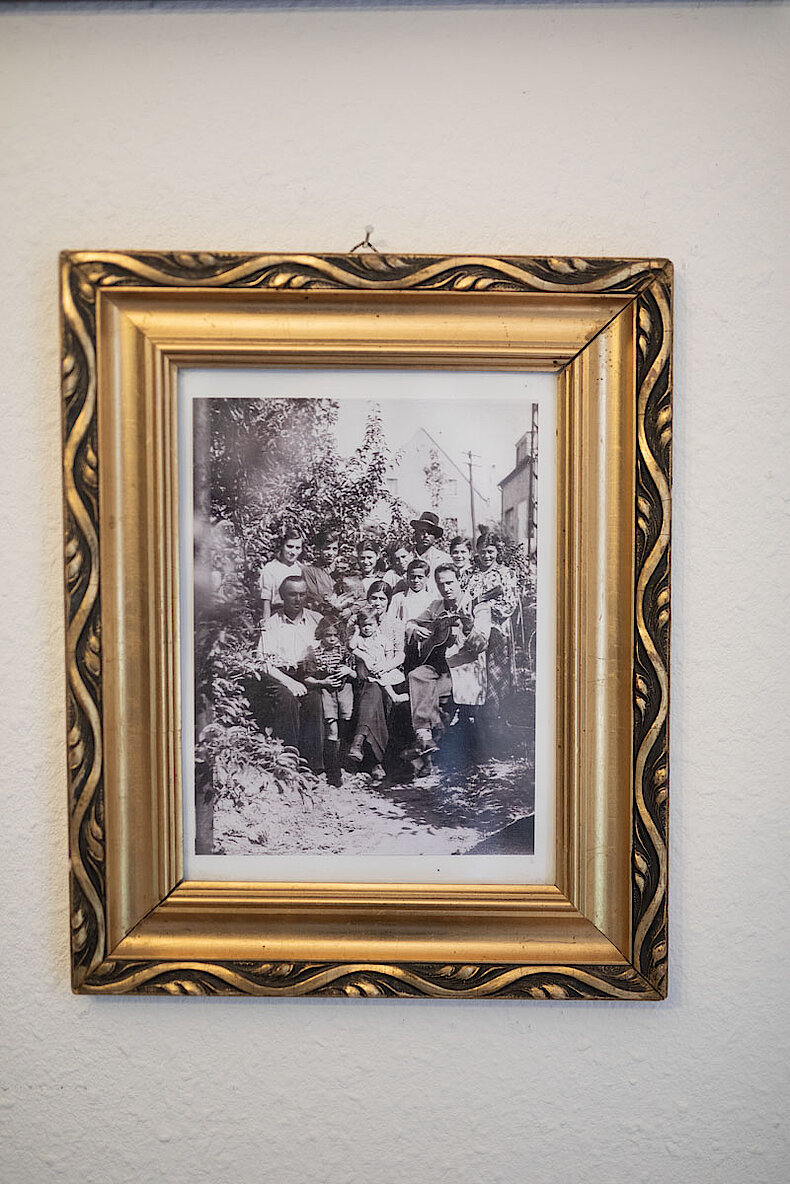
A Picture To Live On
Christian Pfeil was the only one of nine siblings who was able to attend school. His older brothers and sisters were already too old to go to school after the Holocaust, while his younger sister had to leave school because, like him, she had to travel from door to door to help support the family.
He accompanied his parents to all official appointments and soon became the family's voice. When, in his fifties, Christian shared his family's story publicly as a Holocaust survivor for the first time, his relatives reacted with hesitation. They wanted to forget those years and found it too painful to speak about them.
The photograph shows Christian's family. They were always his place of refuge, especially during a childhood in which he was made to feel from an early age that he did not belong to the majority society. Today, in his eighties, he speaks on behalf of his family ‒ with pride ‒ so that young people, in particular, learn about the persecution and discrimination of Sinti and Roma, and so that young Sinti can see someone who inspires them and shows what is possible.
Our Encounter
Christian’s nephew, Sacha, picks us up from our hotel, and together we walk to a small Italian restaurant in the centre of Trier, where Christian is already waiting for us.
He greets us with a handshake that almost immediately turns into a hug. It is obvious that he enjoys being around people and is genuinely happy to spend the evening in this cosy restaurant. He carefully checks the temperature of the white wine ‒ after all ‒ he ran successful restaurants himself for decades. We raise our glasses, introduce ourselves, and begin exchanging stories and photographs.
Laughing, Christian tells us about the time he had to throw Udo Lindenberg out of his pub. He also shares that he once sang on Broadway ‒ in restaurants. We learn that Christian comes from a family with a renowned fortune-teller, and that he inherited both her gift and her remarkable ability to read people. Little by little, a sense of familiarity begins to grow. By the end of the evening, we are already looking forward to the next day and to recording our interview.
As we leave, Christian is greeted by about half of the other guests in the restaurant. Outside, he quietly asks his nephew to remind him who one of them was. He is well known in Trier and associates the city with many happy memories, but also with fear, disappointment, terror and exclusion.
The next morning, we are surprisingly nervous. For many years, we had hoped to interview a Holocaust survivor from the Sinti or Roma communities. The genocide of Sinti and Roma, the second-largest group persecuted by the Nazis, was not officially recognised by the German government until 1982. Even today, it is often overlooked in public remembrance. This is certainly one reason why so few surviving Sinti and Roma have spoken publicly about their experiences.
Christian tells us that, even as a young boy, he was determined to show his family, the people of Trier and the wider world what a Sinto could achieve. From an early age, he also found himself becoming the voice of his family.
As we walk back towards the train station after visiting his apartment, we talk about his remarkable resilience, his determination to prove himself time and again, to rise after every setback and to rebuild his life over and over again. Christian Pfeil left a lasting impression on us: through both his seriousness and his warmth, his courage, and the pride he takes in being a Sinto.